

Updated 24 June 2026 · About the team
If you only memorise one thing about Teen Patti, make it the sequence list. Every decision — whether to chaal, raise, request a sideshow or pack — comes back to one question: does my hand beat theirs? This guide lays out the full ranking order, with examples for each hand and answers to the questions players ask most.
Play now on Teen Patti Lucky
India's favourite card games on your phone — claim your welcome bonus, play cash tables and tournaments, and withdraw to UPI.
Download Teen Patti Lucky →Teen Patti Sequence List (High to Low)
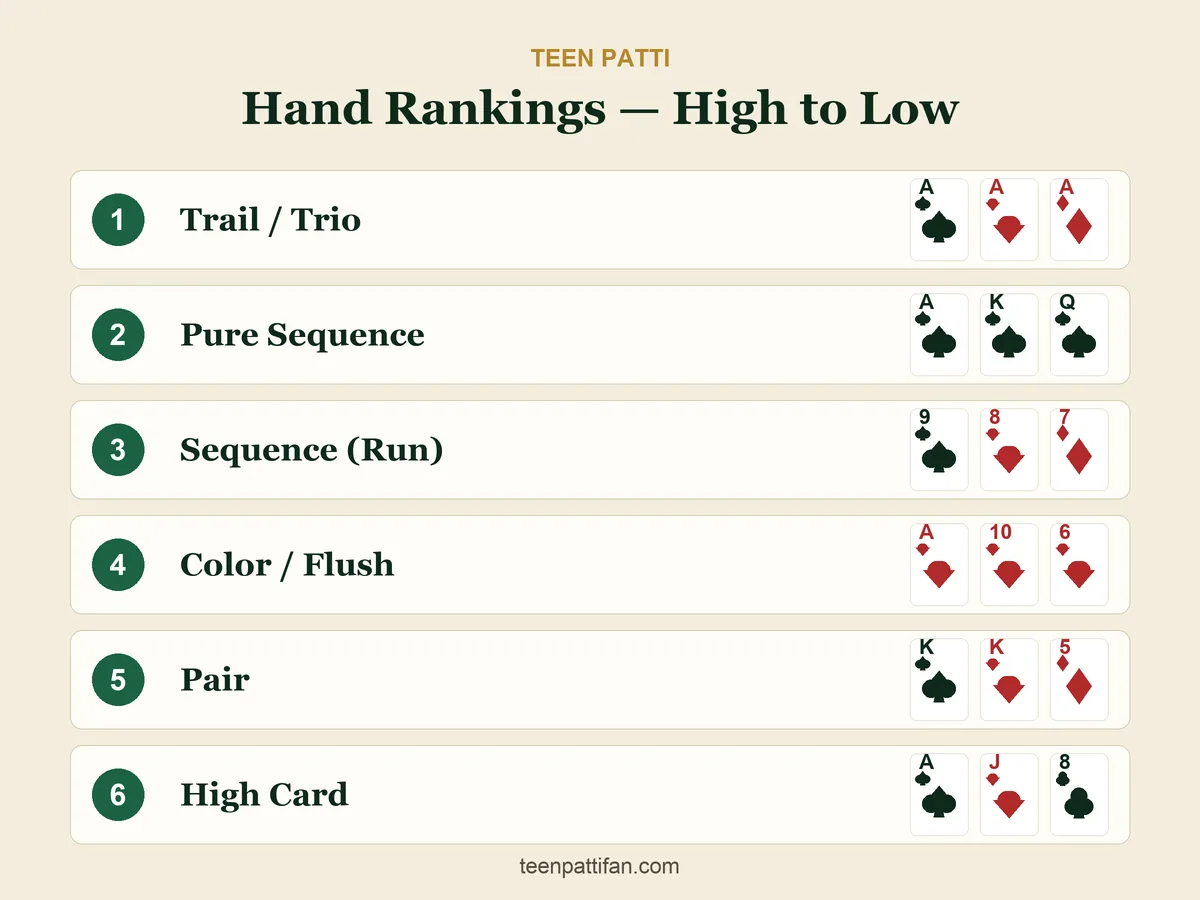
Here is the standard order used in almost every casual and app-based game. Anything higher on this list beats everything below it.
| Rank | Hand | What it is | Example |
|---|---|---|---|
| 1 | Trail / Trio | Three cards of the same rank | A-A-A |
| 2 | Pure Sequence | Three consecutive cards, same suit | A♠ K♠ Q♠ |
| 3 | Sequence (Run) | Three consecutive cards, mixed suits | 9♠ 8♥ 7♦ |
| 4 | Color / Flush | Same suit, not consecutive | A♥ 10♥ 6♥ |
| 5 | Pair | Two cards of the same rank | K-K-5 |
| 6 | High Card | No combination — highest card counts | A-J-8 |
The Teen Patti Sequence List in Pictures
Words and tables are one thing, but the order clicks faster when you can see it. Here is each hand drawn out with real cards, strongest at the top — screenshot it and the whole sequence list lives on your phone.
Each Hand Explained
Trail (Trio): the strongest hand. Three Aces (A-A-A) is the best possible Trail; three 2s is the weakest. Rare, and almost unbeatable when you hold one.
Pure Sequence: three consecutive cards in the same suit, such as 8-9-10 of hearts. A common surprise for beginners is that a pure sequence beats a color — sequence order matters more than suit alone.
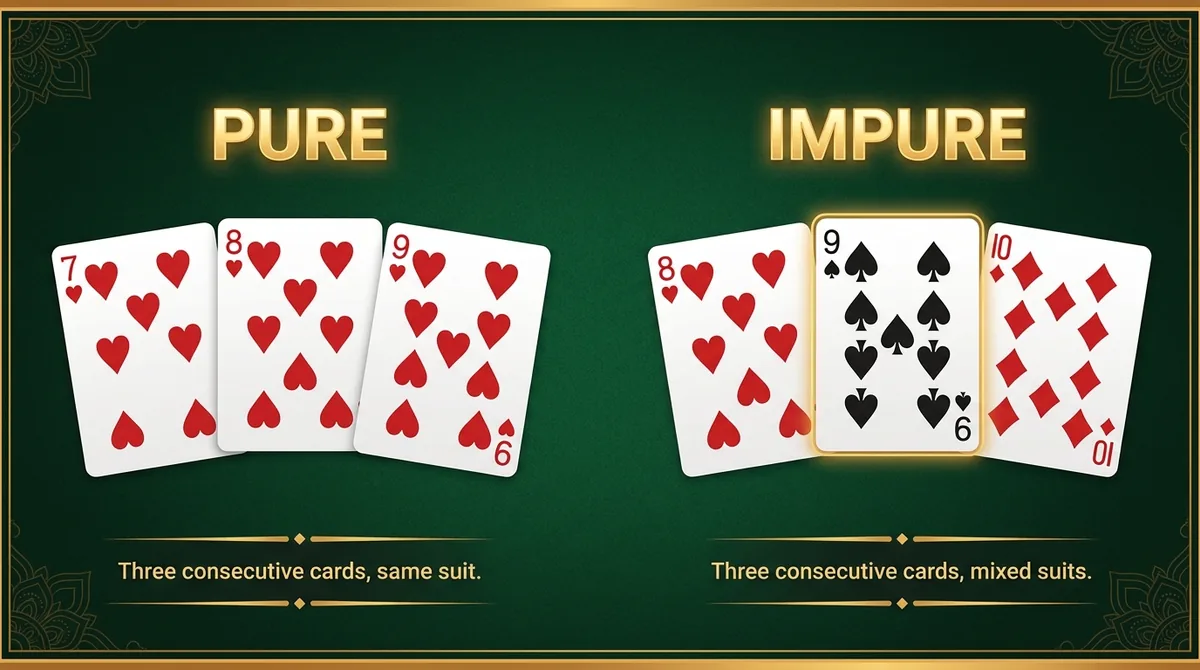
Sequence (Run): three consecutive cards in mixed suits, like 9♠ 8♥ 7♦. Same shape as a pure sequence, but because the suits differ it ranks one step lower.
Color (Flush): three cards of one suit that are not consecutive. When two players both hold a color, compare the highest card, then the next, and so on.
Pair: two cards of the same rank plus a third card. Higher pairs beat lower pairs; if the pairs match, the third "kicker" card decides.
High Card: no combination at all. The single highest card decides, then the next. A-high is the strongest high card.
Many beginners assume a color beats a sequence because "all one suit looks strong." It does not. Pure sequence > plain sequence > color. Lock that order in.
A-K-Q vs A-2-3: Which Sequence Is Higher?
This is the single most-asked Teen Patti ranking question. Under the most common rules:
- A-K-Q is the highest sequence (pure or plain).
- A-2-3 is usually the second highest — it outranks K-Q-J.
- 2-3-4 is the lowest sequence.
Note that A-K-Q wraps the Ace to the top, while A-2-3 wraps it to the bottom — but K-A-2 is not a valid sequence, because the run cannot "go around the corner." House rules occasionally differ, so confirm before the first deal.
Whether A-2-3 outranks K-Q-J, how sideshows work, and any joker variants change from table to table. A 30-second agreement before the boot saves arguments later.
How Ties Are Broken
When two players hold the same type of hand, Teen Patti compares card values:
- Two trails: the higher rank wins (A-A-A beats K-K-K).
- Two sequences: compare the top card; A-K-Q beats Q-J-10.
- Two colors: compare highest card, then second, then third.
- Two pairs: higher pair wins; if equal, the kicker decides.
Rummy Sequence Examples (Pure & Impure) — Visual Guide
Because so many players search for "rummy sequence images" alongside the Teen Patti sequence list, it helps to picture exactly what each combination looks like with real cards. A pure sequence is a run of three or more consecutive cards all in the same suit, with no joker used — for example 5♥-6♥-7♥ or 9♠-10♠-J♠. The cards climb in order and never break suit, which is exactly why it is the cleanest, strongest run you can hold.
An impure sequence is the same idea — consecutive cards — but a joker stands in for a missing card. Picture 5♥-6♥-(joker) standing in for 7♥, or 4♣-(joker)-6♣ where the joker plays the 5♣. The run is valid, but because a wild card props it up it counts as impure, and in 13-card rummy it cannot satisfy the compulsory pure-sequence requirement.
Do not confuse either with a set, which is three or four cards of the same rank but different suits, such as 8♠-8♥-8♦. A set runs sideways across suits; a sequence runs forward through ranks. In Teen Patti the same picture applies but a sequence is always exactly three cards: a pure sequence such as 8♠-9♠-10♠ (same suit) outranks a plain run like 9♠-8♥-7♦ (mixed suits). Use the card images above as your quick reference for what every pure and impure run should look like.
Teen Patti Sequence vs Rummy Sequence
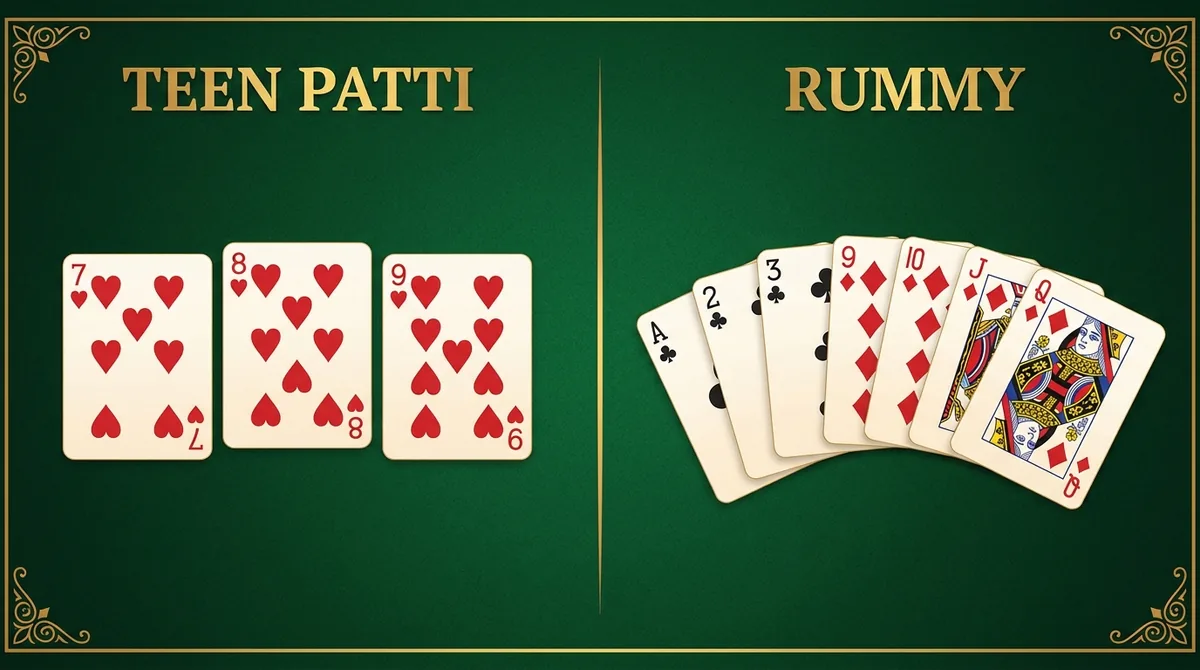
A lot of players search for "sequence list" with rummy in mind, not Teen Patti — and the two are close cousins but not identical. Since the same deck and the same "consecutive cards" idea power both games, here is how a sequence works on each side so you do not mix them up.
| Teen Patti | 13-Card Rummy | |
|---|---|---|
| Cards in a sequence | Exactly 3 | 3 or more (e.g. 5-6-7-8) |
| "Pure" sequence | 3 consecutive, same suit (e.g. 8♠ 9♠ 10♠) | 3+ consecutive, same suit, no joker |
| "Impure" / plain | 3 consecutive, mixed suits | Run that uses a joker as a wild card |
| Is it mandatory? | No — it is just one ranked hand | Yes — you need at least one pure sequence to declare |
| Ace position | A-K-Q (high) or A-2-3 (low); no wrap-around | Ace works high or low (A-2-3 and Q-K-A both valid) |
The big practical difference: in Teen Patti a sequence is one possible three-card hand, while in rummy a pure sequence is compulsory — without one, your whole hand is invalid no matter how good the rest looks. If rummy is what you were really after, our pure sequence in rummy guide shows exactly how to build one, and the full 13-card Indian rummy rules cover sets, declaration and scoring.
If you enjoy spotting runs in Teen Patti, rummy rewards the same instinct — just over a longer hand. Many of our readers play both, and the bonus apps in our rummy app list bundle Teen Patti tables too.
Want the full rules, not just the list?
Our main Teen Patti guide covers the betting flow, blind vs seen play, sideshow rules and every popular variant.
Read the Teen Patti guide →FAQ
Rohan Mehta
Rohan grew up playing Teen Patti at Diwali gatherings in Jaipur and has spent over a decade writing about Indian card games. He started Teen Patti Lucky to explain the rules clearly, without hype. More about our team →