

Updated 24 June 2026 · About the team
If you typed “13 Patti” expecting another Teen Patti page, here is the thing that trips everyone up: “13 Patti” is not the three-card game. It is the thirteen-card game — what most people simply call Indian Rummy. The name is literal: patti means cards, and you play with thirteen of them. This guide explains what 13 Patti is, the full rules, and the one thing (the pure sequence) that decides every hand.
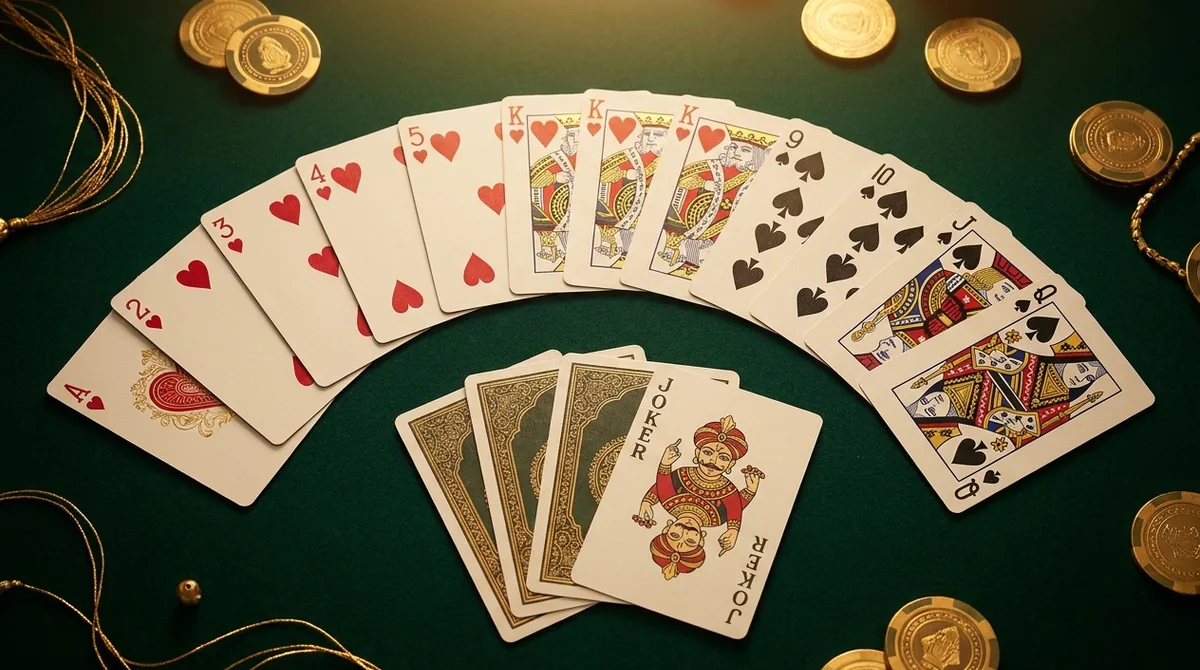
Play 13 Patti on Teen Patti Stars
Practice tables and cash rummy on your phone — learn by playing, claim a welcome bonus, and withdraw to UPI. 18+, APK download.
Download Teen Patti Stars →What Is 13 Patti?
13 Patti is 13-card Indian Rummy. It goes by several names — 13 Cards, 13 Card Rummy, Paplu, or just Indian Rummy — but they all describe the same game. You are dealt 13 cards and your job is to arrange every one of them into valid sequences (runs) and sets (groups of the same rank), then be the first to declare a complete, valid hand.
The single rule that defines the game: you must have at least two sequences, and at least one of them must be a pure sequence (a run with no joker). Get that wrong and your declaration is invalid — even if every other card is perfectly grouped. That one requirement is what separates winners from “wrong show” penalties.
The number is the fastest way to tell the two games apart. 3 Patti / Teen Patti = 3 cards (a betting and bluffing game). 13 Patti = 13 cards (a melding and skill game). Same deck, very different game.
13 Patti: The Quick Rules
| Element | 13 Patti rule |
|---|---|
| Players | 2 to 6 |
| Cards dealt | 13 to each player |
| Decks | Two 52-card decks + printed jokers (for 2+ players) |
| Wild joker | One card is turned up; all cards of that rank become jokers for the round |
| Goal | Group all 13 cards into valid sequences & sets, then declare |
| Must-have | At least 2 sequences, and at least 1 of them a pure sequence |
On your turn you pick one card (from the closed deck or the open discard pile) and throw one away, slowly shaping your 13 cards into groups. The moment all 13 form valid groups with the pure-sequence rule satisfied, you put your hand down for a “show” and win.
Sequences and Sets — the Two Building Blocks
Every valid 13 Patti hand is built from just two shapes. Get these and you understand the whole game.
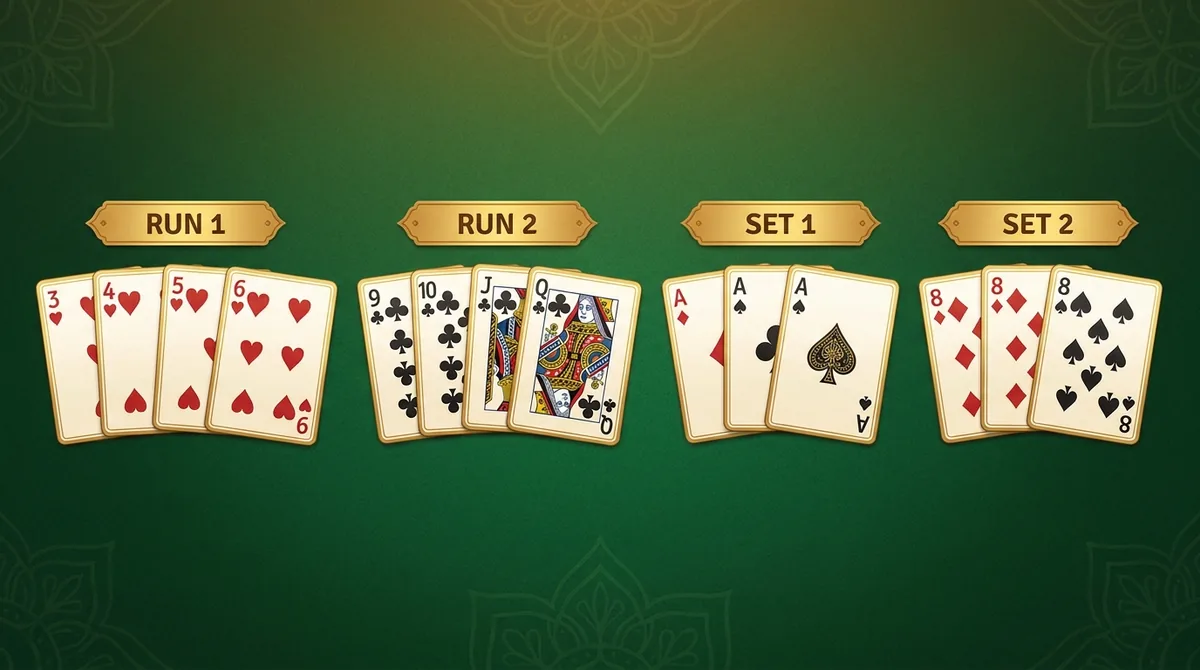
Sequence (run): three or more consecutive cards of the same suit. A pure sequence uses no joker (e.g. 4♥-5♥-6♥); an impure sequence uses a joker to fill a gap (e.g. 4♥-[Joker]-6♥).
Set (group): three or four cards of the same rank but different suits — for example 7♠-7♥-7♣. A joker can complete a set too.
Here is one valid way to arrange a 13-card hand — two sequences (one pure) plus two sets, every card accounted for:
KERJ♠
That is 3 + 3 + 3 + 4 = 13 cards, two sequences (one pure) and two sets — a valid winning 13 Patti hand.
The Pure Sequence: the Rule That Wins or Loses 13 Patti
Everything in 13 Patti hangs on one card group. A pure sequence is three or more consecutive cards of the same suit with no joker — like 5♥-6♥-7♥ above. You need at least one, full stop. Declare without it and you get a wrong show penalty of up to 80 points, no matter how tidy the rest of your hand looks.
So the smart order of play is: build your pure sequence first, then a second sequence, then mop up the rest into sets using your jokers. We break this down further in our dedicated pure sequence in rummy guide, and the complete ruleset lives in 13-card Indian Rummy rules.
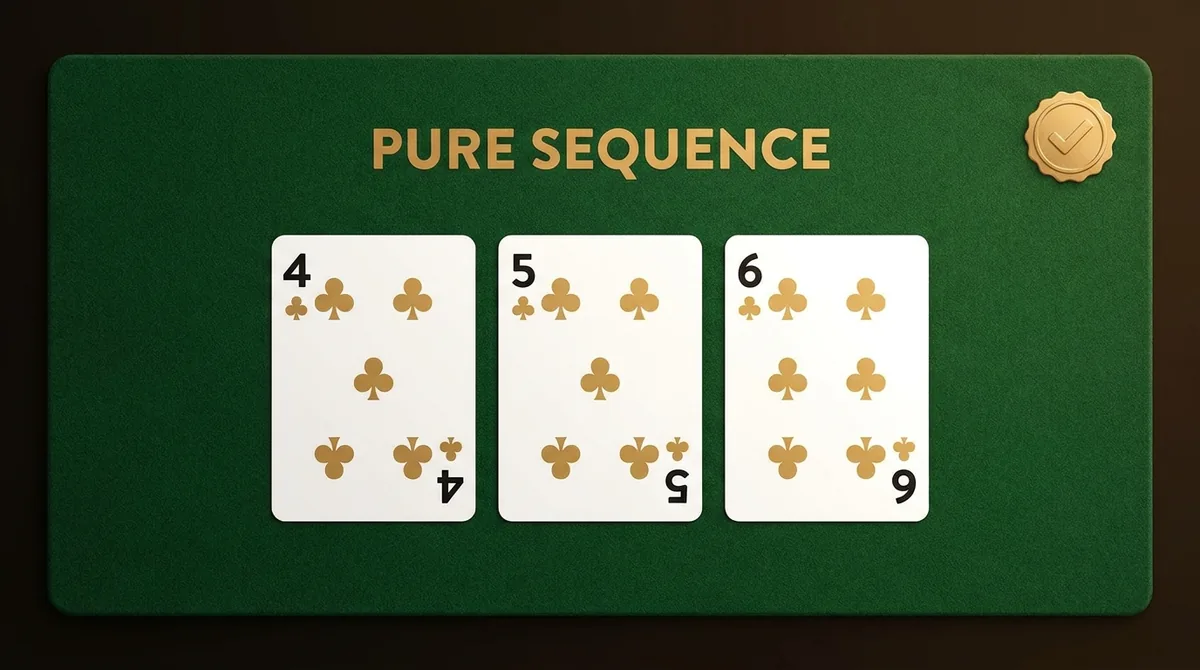
A joker makes a sequence impure by definition. It can complete your second sequence and your sets — but your one compulsory pure sequence must be all natural cards.
How Scoring Works in 13 Patti
13 Patti is a points game, and in rummy low is good. The winner declares with zero points; everyone else scores the value of the cards they failed to group:
- Number cards are worth their face value (a 7 = 7 points).
- Face cards (J, Q, K) and Aces are worth 10 points each.
- Jokers are worth 0.
- A wrong declaration costs a flat penalty (commonly 80), and a first-drop or middle-drop costs 20 / 40.
Your loss in any deal is capped at 80 points, so even a terrible hand has a known worst case — another reason 13 Patti rewards calm, skillful play over wild gambling.
13 Patti vs 3 Patti: the Difference in One Table
Because the names look so similar, here is the side-by-side that clears it up for good.
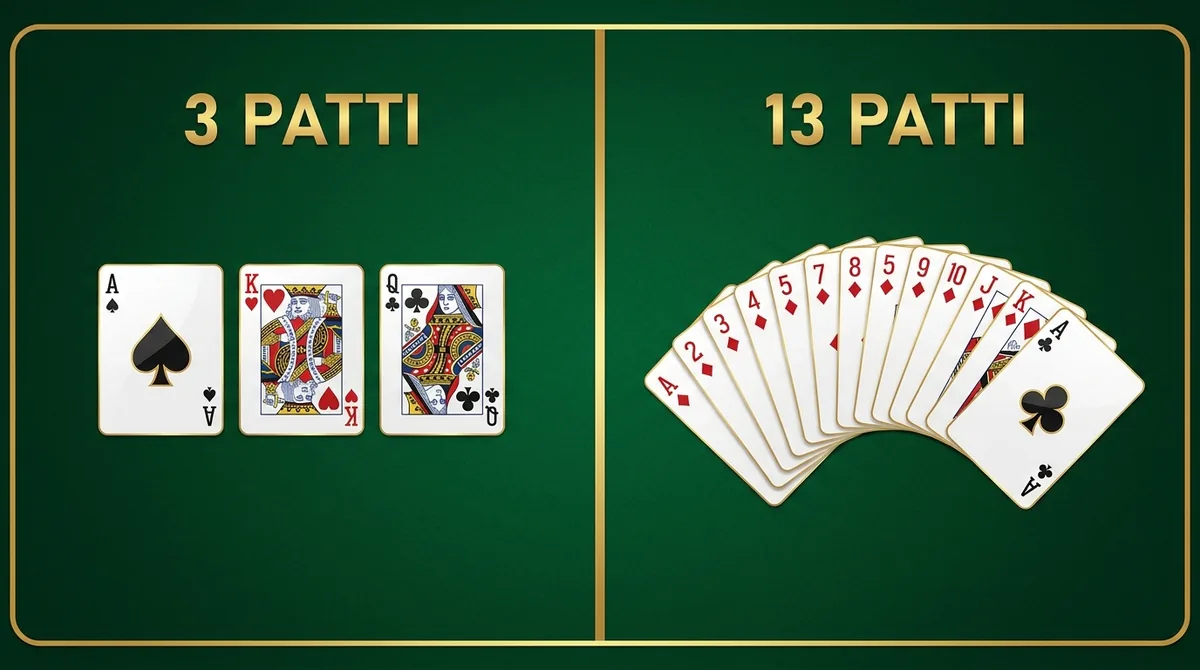
| 13 Patti (Indian Rummy) | 3 Patti (Teen Patti) | |
|---|---|---|
| Cards per player | 13 | 3 |
| Type of game | Melding / skill | Betting / bluffing |
| Goal | Form sequences & sets, then declare | Hold (or bluff) the best 3-card hand |
| Pure sequence | Compulsory to win | Just one ranked hand, not required |
| Jokers | Used to complete groups | Only in joker variants |
| Scoring | Low points win (0 is best) | Highest hand / last player standing wins the pot |
Came here for the three-card game after all? Jump to our 3 Patti sequence list for hand rankings, or the full how to play Teen Patti guide. Want to go deeper on 13 Patti? Start with the Indian Rummy rules and how to win at rummy.
Learn 13 Patti by playing on Teen Patti Stars
Free practice tables are the fastest way to lock in sequences and sets. Play rummy and 3 Patti in one app — 18+, APK download.
Download Teen Patti Stars →FAQ
Priya Nair
Priya is a competitive 13-card rummy player from Kochi who has spent years coaching friends through their first “13 Patti” games. She writes our rummy rules and strategy guides. More about our team →