Complete Indian player guide
Teen Patti Guide For Indian Players
Teen Patti is India's classic three-card game. Each player tries to make, hide or represent a stronger three-card hand than the others, then win the pot through betting pressure, packing decisions or the final show.
Game basics
What Is Teen Patti?
| Topic | Gameplay Explanation |
|---|---|
| Basic idea | Teen Patti is a three-card comparison game played around a shared pot. |
| Why it is popular in India | Rounds are quick, rules are simple to teach, and the game works well at family gatherings, festivals and friend groups. |
| Main objective | Use three cards to make a stronger hand than other active players, or make them pack before cards are shown. |
| Winning the pot | The last active player wins if everyone else packs; otherwise the strongest hand wins at show. |
| Best first step | Learn the hand rankings first, because every call, raise, pack and sideshow depends on hand strength. |
Setup
Teen Patti Game Preparation
| Item | Standard Rule |
|---|---|
| Players | Usually 3 to 6 players sit in one round. |
| Deck | One standard 52-card deck is used, without jokers unless the variant says otherwise. |
| Cards | Each player receives 3 face-down cards. |
| Dealer | The dealer shuffles and deals cards. In casual games, the dealer role often rotates each round. |
| Boot | Boot is the basic opening contribution every player puts in before cards are dealt. |
| Pot | Pot is the total amount in the center of the table that active players are trying to win. |
| Turn order | Action usually moves clockwise from the player next to the dealer. |
Hand strength
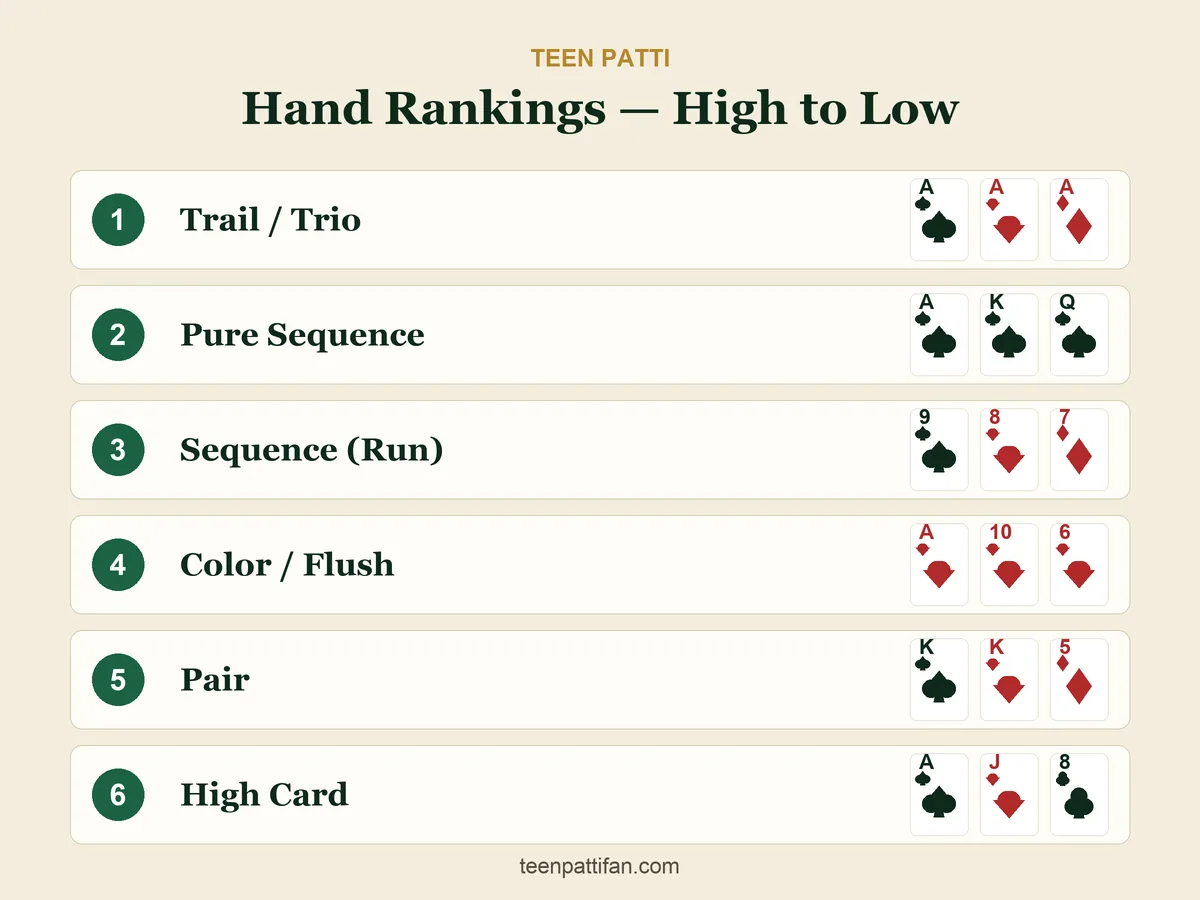
Teen Patti Hand Rankings From High To Low
| Hand | English | Example |
|---|---|---|
| Three of a kind | Trail / Trio | A-A-A |
| Straight flush | Pure Sequence | A-K-Q of the same suit |
| Straight | Sequence | 7-8-9 in mixed suits |
| Flush | Color / Flush | A-10-6 of the same suit |
| Pair | Pair | K-K-5 |
| High card | High Card | A-J-8 |
Round flow
Basic Teen Patti Gameplay Flow
| Step | What Happens |
|---|---|
| 1. Boot | All players place the boot to create the starting pot. |
| 2. Deal | The dealer gives 3 face-down cards to each player. |
| 3. Blind or seen | Players choose whether to continue without looking at cards or look first and play seen. |
| 4. Betting action | In turn, players may chaal, raise, pack or request sideshow when allowed. |
| 5. Show | When the round reaches show, active players reveal cards. |
| 6. Winner | The player with the strongest hand ranking wins the pot. |
Blind and seen
Blind Vs Seen Play
| Mode | Meaning | When It Helps | Risk |
|---|---|---|---|
| Blind | You continue without looking at your cards. | Useful early when you want to keep pressure and avoid revealing confidence. | You may keep paying with a weak hand because you have no card information. |
| Seen | You look at your cards before acting. | Useful when you need to judge whether to chaal, raise, pack or request sideshow. | Seen players often need to pay a higher stake than blind players under common rules. |
| Blind player stake | A blind player usually pays a smaller current stake. | This can make blind play attractive in the early round. | Long blind streaks can become expensive if the pot keeps growing. |
| Seen player stake | A seen player usually pays more because they have card information. | Good for controlled decisions with pair, sequence, color or better. | Weak seen hands should often pack instead of paying into a large pot. |
Table terms
Common Teen Patti Terms
| Term | Meaning |
|---|---|
| Boot | The basic opening contribution placed by each player before cards are dealt. |
| Pot | The total chips in the center of the table. |
| Blind | Playing without looking at your cards. |
| Seen | Playing after looking at your cards. |
| Chaal | Continuing in the hand by matching the required stake. |
| Raise | Increasing the current stake to put more pressure on other players. |
| Pack / Fold | Leaving the current round and giving up claim to the pot. |
| Show | Revealing cards to compare hand strength. |
| Sideshow / Compromise | A request to privately compare cards with the previous active player when rules allow. |
Show rules
Show And Sideshow Rules
| Rule | How It Usually Works |
|---|---|
| Requesting show | A show is usually requested when only two active players remain, though house rules can change this. |
| Show result | Both active players reveal cards, and the higher-ranked hand wins the pot. |
| Starting a sideshow | A seen player may ask the previous active player for a private comparison when sideshow is allowed. |
| If accepted | The two hands are compared privately. The weaker hand must pack. |
| If rejected | The requesting player continues the turn by playing normally; the round does not end. |
| Same hand category | Compare highest card first, then second card, then third card. For a pair, compare pair rank first, then the kicker. |
Example round
Complete Teen Patti Round Example
| Moment | Example |
|---|---|
| Players join | Player A, B, C and D enter the round. Each puts 10 chips as boot, so the pot starts with 40 chips. |
| Cards are dealt | Dealer gives 3 face-down cards to every player. |
| A plays blind | Player A does not look at cards and continues as a blind player. |
| B plays seen | Player B sees K-K-5 and makes chaal because a pair is a playable hand. |
| C packs | Player C sees A-J-8. It is only high card, so C packs instead of chasing the pot. |
| D raises | Player D sees 7-8-9 in mixed suits, a sequence, and raises to put pressure on B and A. |
| B packs | Player B has a pair, but D's raise suggests strength, so B decides to pack. |
| A and D show | Only A and D remain. A reveals A-10-6 of the same suit, which is color. D reveals 7-8-9 sequence. |
| Winner | Sequence beats color, so Player D wins the pot. |
Beginner tips
Teen Patti Tips For New Players
- Do not follow every hand to the end. Packing weak cards is part of good play.
- High card is not automatically strong. Pair, color, sequence, pure sequence and trail all beat it.
- Pair or better is usually more suitable for active pressure than random high-card hands.
- Blind play can create pressure, but using it too often makes decisions careless.
- After seeing your cards, decide from the hand ranking whether to continue or pack.
- Watch the rhythm of other players: who raises quickly, who packs early and who bluffs often.
Advanced tips
Better Teen Patti Decision Making
- Use position advantage. Acting later gives more information about other players' confidence.
- Compare the pot size with your hand strength before continuing.
- Use raise to test whether opponents are confident or just staying in cheaply.
- Observe who bluffs too often and who only raises with strong cards.
- Avoid sideshow with very weak hands unless the situation strongly favors it.
- With a strong hand, do not raise so aggressively that every opponent packs immediately.
Variants
Common Teen Patti Variations
| Variant | Rule Twist |
|---|---|
| Muflis | The weakest hand wins instead of the strongest hand. |
| AK47 | Aces, kings, fours and sevens act as jokers. |
| Joker Teen Patti | One or more cards are selected as wild cards. |
| 999 | The hand closest to 9-9-9 wins. |
| Best of Four | Each player receives 4 cards and chooses the best 3-card hand. |
| Hukam | A chosen suit or card type receives a special role under house rules. |
| 2x Boot / 4x Boot | Higher boot levels create faster, more aggressive rounds. |
Indian table habits
Rules To Confirm Before A Game
- Teen Patti is common during Diwali, festivals and friend gatherings, where house rules may be relaxed.
- Family games often use simplified rules, especially for sideshow and joker variants.
- Different regions or groups may rank special sequences, jokers or show conditions differently.
- Before the first deal, confirm boot amount, show rules, sideshow rules, joker rules and whether variants are being used.
FAQ
Common Questions
What is the highest hand in Teen Patti?
Trail, also called trio or three of a kind, is the highest standard Teen Patti hand. A-A-A is the strongest trail.
Which is bigger, Trail or Pure Sequence?
Trail is bigger than Pure Sequence in standard Teen Patti hand rankings.
Can a blind player keep playing without seeing cards?
Usually yes, until the player chooses to see, packs, reaches a house-rule limit or the round reaches show conditions.
Can sideshow be rejected?
Yes. If the previous active player rejects a sideshow request, the requesting player continues normally and the round goes on.
Which sequence is bigger, A-K-Q or A-2-3?
In common Teen Patti rules, A-K-Q is the highest sequence and A-2-3 is usually the second-highest sequence. Confirm house rules before playing.
How do you compare pairs?
Compare the rank of the pair first. If both players have the same pair, compare the third card, also called the kicker.
Download APK