

Updated 11 June 2026 · About the team
In 13-card Indian Rummy, one rule sits above all others: you cannot make a valid declaration without at least one pure sequence. Beginners lose countless games by assembling a tidy-looking hand and forgetting this requirement. Get the pure sequence right and everything else becomes easier.
Play now on Teen Patti Octro
India's favourite card games on your phone — claim your welcome bonus, play cash tables and tournaments, and withdraw to UPI.
Download Teen Patti Octro →What is a pure sequence?
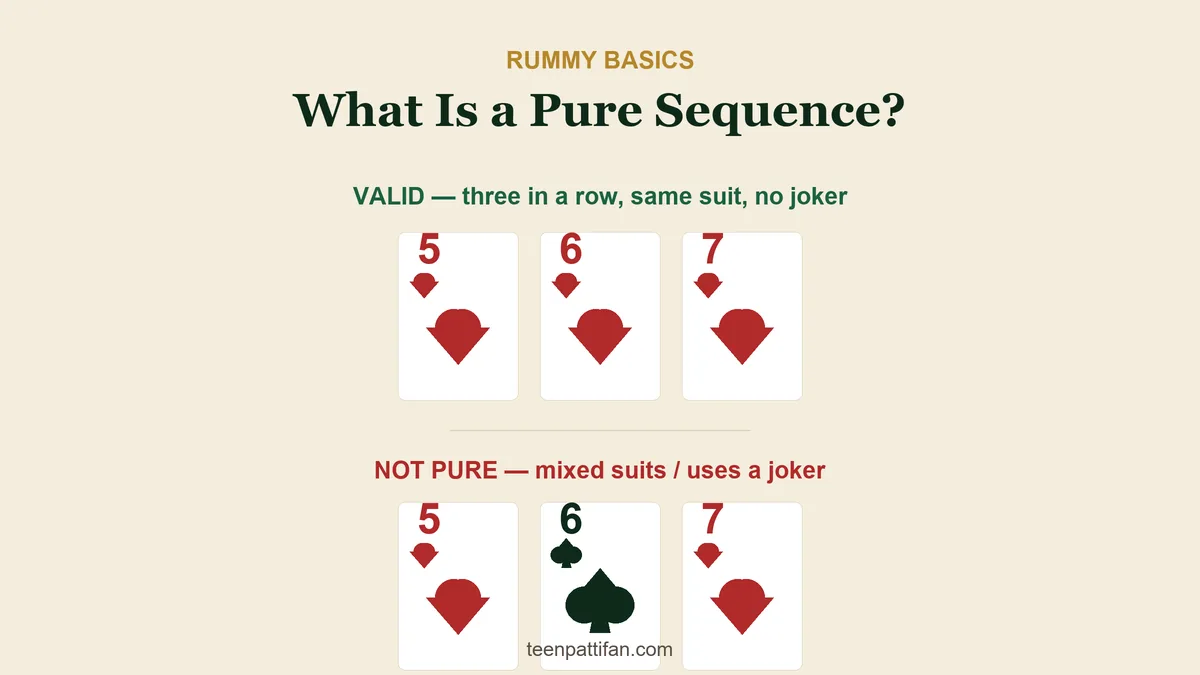
A pure sequence is three or more consecutive cards of the same suit, formed without any joker. For example, 5♥ 6♥ 7♥ is a pure sequence. Four cards in a row of one suit — such as 8♠ 9♠ 10♠ J♠ — is also a valid (and longer) pure sequence.
The defining feature is that no joker is involved. The moment a joker stands in for a missing card, the group becomes an impure sequence instead.
Valid vs invalid examples
| Example | Pure? | Why |
|---|---|---|
| 5♥ 6♥ 7♥ | Yes | Consecutive, same suit, no joker |
| 9♠ 10♠ J♠ Q♠ | Yes | Four-card run, same suit, no joker |
| 5♥ 6♠ 7♥ | No | Mixed suits — this is not a sequence at all |
| 5♥ Joker 7♥ | No | Uses a joker — this is an impure sequence |
| K♦ A♦ 2♦ | No | A run cannot wrap from K-A-2 |
Pure sequence = no joker. Impure sequence = a joker fills a gap. You need at least one pure sequence to declare; impure ones only count toward your second sequence and sets.
Why it matters so much
To win a round of Rummy you arrange all 13 cards into valid sequences and sets and then declare. A valid declaration needs at least two sequences, and at least one of them must be pure. If you declare without a pure sequence, the declaration is invalid — and you typically take the maximum 80-point penalty even if every other group was complete. That is why experienced players treat the pure sequence as job number one.
How to build one fast
- Make it your first priority. Before chasing sets or impure runs, lock in a pure sequence.
- Keep connected cards. Holding 6♥ 7♥ gives you two ways to complete (5♥ or 8♥) — far better odds than a gap.
- Don't waste jokers here. Jokers cannot help a pure sequence, so save them for your second sequence and sets.
- Discard high unconnected cards early. Lone Aces, Kings and Queens with no neighbours add risk; release them before they cost points.
- Watch the discard pile. Picking the exact card you need beats drawing blind from the closed deck.
A wrong declaration usually costs the full penalty. Before committing, confirm your pure sequence is genuinely joker-free and that you have a second sequence too.
Want the complete Rummy rules?
Our main Rummy guide covers sequences, sets, jokers, points calculation and exactly what makes a valid declaration.
Read the Rummy guide →FAQ
Priya Nair
Priya is a competitive Rummy player from Kochi who has spent years coaching beginners through the rules and declaration traps. She writes our Rummy and sequence guides. More about our team →