

Updated 11 June 2026 · About the team
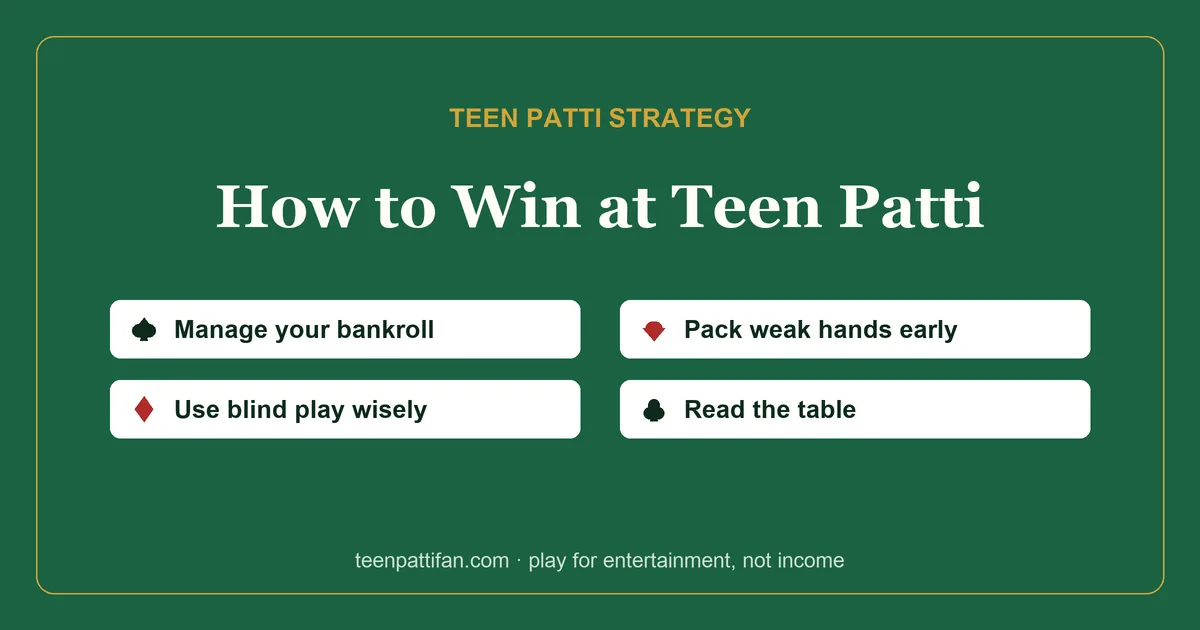
Teen Patti is part luck, part skill. You cannot control the cards, but you can control how much you risk, when you fold, and how you read the table — and over many hands those decisions separate steady players from chasers. Here are ten tips that genuinely help, written honestly: none of them guarantee a win, and anyone who promises that is selling something.
Play now on Teen Patti Joy
India's favourite card games on your phone — claim your welcome bonus, play cash tables and tournaments, and withdraw to UPI.
Download Teen Patti Joy →1. Set a bankroll before you sit down
Decide the maximum you are willing to lose before the first deal, and stop when you reach it — win or lose. This single habit protects you more than any card trick. Never chase losses by raising stakes to "win it back."
2. Folding is a winning move
Packing weak cards is good discipline, not weakness. You do not have to follow every hand to a show. Players who fold marginal hands early lose small and stay in the game; players who call everything bleed chips slowly.
3. Know the hand order cold
You cannot bet well if you hesitate on what beats what. Memorise the order — Trail, Pure Sequence, Sequence, Color, Pair, High Card — so it is automatic. Our Teen Patti sequence list covers it with examples.
4. Use blind play for cheap pressure
A blind player usually pays a smaller stake, which lets you apply pressure without committing much. Used occasionally it disguises your hand and unsettles seen players. Used constantly, it just makes your decisions careless.
5. When seen, slow down and think
Once you have looked, play with intent. A strong hand is worth building a pot around; a weak one is worth folding cheaply. Avoid the trap of paying "just one more" turn out of curiosity.
6. Watch position and player count
Acting later gives you more information about how others are betting. Early on, with many players still in, marginal hands are worth less — someone is more likely to hold something strong. Tighten up when the table is full.
7. Read the table, not just your cards
Observation is the most underrated skill. Note who raises fast, who packs early, who bluffs often. Patterns repeat. The information in how people bet is frequently worth more than the cards in your hand.
8. Bluff with a story, not at random
Bluffing works when your betting tells a believable story. Random aggression gets called and costs you chips. Pick your moments — ideally against cautious players, in smaller pots, when your earlier play supports the bluff.
9. Compare pot size to hand strength
Before you keep paying in, weigh the growing pot against how good your hand really is. A medium hand in a small pot is fine to continue; the same hand in a bloated, aggressive pot usually is not.
10. Quit while you are calm
Tilt — playing emotionally after a big loss or win — destroys more bankrolls than bad cards. Set a time limit alongside your money limit, and walk away on schedule.
Good Teen Patti is mostly discipline: fold often, bet with purpose, read opponents, and protect your bankroll. Skill improves your odds — it never removes the luck.
Myths that lose players money
| Myth | Reality |
|---|---|
| "I'm due for a win after losing." | Each deal is independent. Past losses don't make a win more likely. |
| "Blind play always beats seen." | Blind is cheap pressure, not a strength edge. Overusing it is costly. |
| "A color is basically a sequence." | No — any sequence beats a color. Suit alone is weaker than order. |
| "There's a guaranteed system." | There isn't. The deal is random; treat the game as entertainment. |
New to the game?
Start with the complete rules — boot, deal, blind vs seen, show and sideshow — then come back to these tips.
Read the Teen Patti rules →FAQ
Rohan Mehta
Rohan grew up playing Teen Patti at Diwali gatherings in Jaipur and has spent over a decade writing about Indian card games. He believes good strategy content should be honest about luck and risk. More about our team →