

Updated 15 June 2026 · About the team
If you already know how 13-card Indian rummy works, pool rummy is the same game wrapped in an elimination scoreboard. Instead of a single hand deciding the winner, you play deal after deal, carrying your losing points forward until everyone but one player has crossed the pool limit. It is the format most online tables and family tournaments use, because it stretches one sitting into a proper contest of patience.
Play now on Teen Patti Lucky
India's favourite card games on your phone — claim your welcome bonus, play cash tables and tournaments, and withdraw to UPI.
Download Teen Patti Lucky →On this page
What Is Pool Rummy?
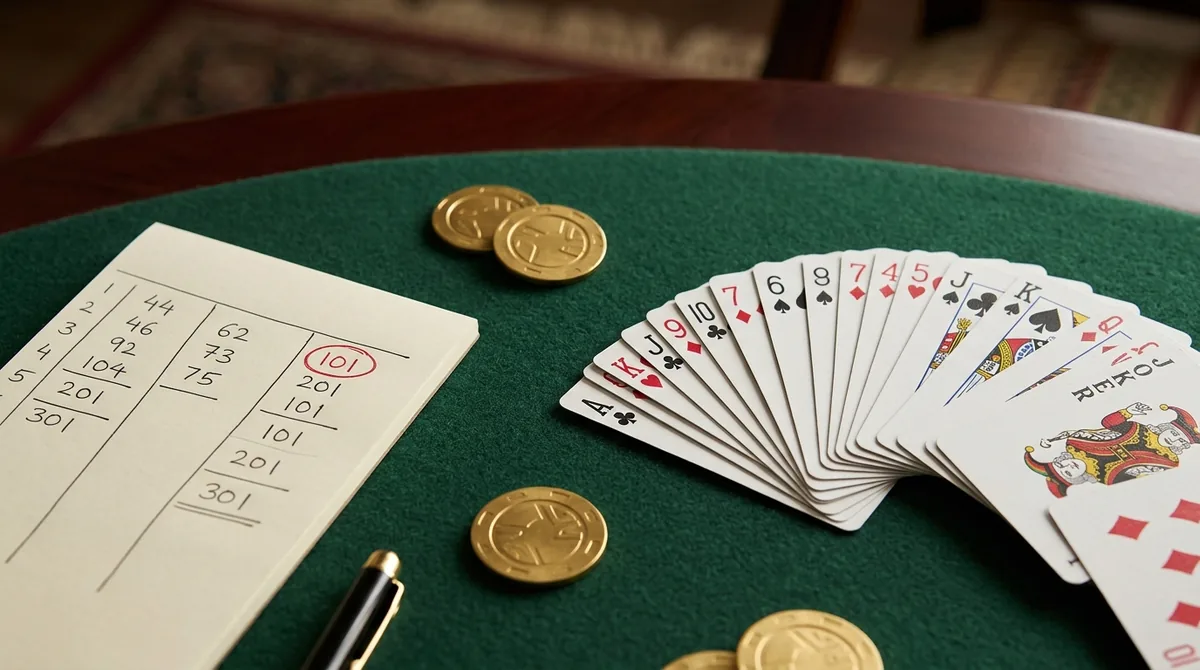
Pool rummy is a points-based, elimination version of 13-card rummy. Every player starts on zero. Each deal is played like normal rummy — build sequences and sets, make a valid declaration — but the loser of each deal does not just lose the hand: they add that deal's points to a running total. The moment your total reaches or crosses the pool limit, you are eliminated. Play continues until only one player remains under the limit, and that player wins the pool.
The name comes from the shared "pool" everyone is playing toward. Unlike deals rummy or points rummy, where a hand or a fixed number of deals settles things quickly, pool rummy is a war of attrition: you win by not losing.
In pool rummy you are not chasing wins — you are dodging elimination. Keep your per-deal points low, let everyone else bust the limit, and the pool is yours.
101, 201 and 61 Pool: What the Numbers Mean
The number in the format name is simply the elimination threshold — the points total that knocks you out. Three variants are common:
| Format | Elimination limit | Typical length | Best for |
|---|---|---|---|
| 101 Pool | 101 points | Medium | The standard format — balanced, the most widely played |
| 201 Pool | 201 points | Long | Patient players; allows re-entry and long comebacks |
| 61 Pool | 61 points | Short | Quick games and time-limited sessions |
The higher the limit, the longer the game and the more room for recovery. In 201 pool rummy, a player eliminated early can often re-enter at the highest current score, so a single bad deal need not end your night. In 61 pool, by contrast, two careless hands can bust you — every point matters from the first deal.
How to Play Pool Rummy, Step by Step
- Pick the format and seats. Two to six players, two standard decks with jokers (the same setup as ordinary 13-card rummy).
- Deal 13 cards each. One card opens the discard pile; the rest form the closed deck. A wild-card joker is fixed for the deal.
- Play the deal normally. Draw and discard in turn, building at least one pure sequence plus valid sequences and sets toward a declaration.
- Score the deal. The winner scores zero. Every other player counts the points of their un-grouped cards (face cards 10, numbers at face value, valid groups zero).
- Add to the running total. Each loser's deal points are added to their pool score.
- Eliminate and repeat. Anyone whose total reaches the limit is out. Deal again with the survivors until one player is left.
Scoring and Elimination
Pool rummy uses the standard rummy points table, with one twist: the points carry forward instead of resetting each deal.
| Cards | Points |
|---|---|
| Ace, King, Queen, Jack | 10 each |
| Number cards (2–10) | Face value |
| Cards already in valid sequences/sets | 0 |
| Wrong declaration | 80 (full count) |
| Maximum a hand can score | Capped at 80 |
Because a single bad deal can add up to 80 points, one collapse in 101 pool can put you on the brink. This is why disciplined, low-point losing matters more than occasional big wins — the same lesson as our how to win rummy guide, amplified across a whole match.
Drops and Re-entry
Dropping — choosing not to play a deal you have been dealt — is the heart of pool strategy. It costs a fixed penalty that is far cheaper than getting caught with a full hand:
| Action | Typical penalty | When to use it |
|---|---|---|
| First drop (before your first turn) | 20 points | A hopeless hand: no joker, scattered suits, many high cards |
| Middle drop (after picking up) | 40 points | A hand that fell apart after a few turns |
| Playing and losing | Up to 80 points | Only when you have a realistic chance to finish |
In 201 pool, an eliminated player can usually re-enter by taking a score equal to the highest surviving total, buying back into the game. In 101 and 61 pool, elimination is normally final. Knowing whether re-entry exists changes how aggressively you should drop early on.
Pool rummy is one of the most popular formats on app — you'll find 101 and 201 pool tables, plus a welcome bonus and daily rewards, on Teen Patti Lucky. Prefer a deck? It plays just as well with friends at home.
Pool Rummy Strategy: Survive, Don't Sprint
- Treat every deal as damage control. You rarely need to win — you need to lose small. A deal where you go out with 8 points is a good deal.
- Drop early and without ego. A 20-point first drop on a bad hand is the most underused winning move in pool rummy. Hopeless hands cost 60–80 if you play them out.
- Secure the pure sequence first. Without it your whole hand counts at full value if someone declares — the single biggest source of pool blow-ups.
- Watch the scoreboard, not just your cards. If a rival is near the limit, play tighter and let them bust. If you are the one near the edge, drop freely to stay alive.
- Punish the leaders late. When only two or three players remain, pressure the ones closest to elimination rather than taking risks yourself.
Pure sequence early, cheap drops on bad hands, and constant attention to who is closest to the limit. Pool rummy rewards the calmest player at the table, not the boldest.
New to the 13-card game?
Pool rummy assumes you already know sequences, sets, jokers and a valid declaration. Start with the full rules, then come back.
Read the Indian Rummy rules →FAQ
Sources & references
- Indian rummy (rules) — the 13-card base game that pool rummy is scored on.
- Rummy — the wider family of draw-and-discard games and their scoring conventions.
- Online gambling in India — the legal status of real-money rummy after the 2025 Act.
External links open in a new tab and are provided for verification. We are an independent guide and are not affiliated with these sources.
Priya Nair
Priya is a competitive Rummy player from Kochi who has spent years coaching beginners through the rules, formats and declaration traps. She writes our Rummy and sequence guides. More about our team →